View our Internships & Jobs page for more opportunities.
Check out these fall 2026 courses!
New Pubic Health Elective: SPHU 4280 Fundamentals of Global Water Security & Sustainability
Tues/Thurs 11:00AM – 12:15PM
Credit Hours: 3
Open to all undergraduates.
This interdisciplinary course explores the science and social dynamics of water security, including water quality, access, reliability, and sustainability from source to household use from environmental, social- behavioral and health perspectives. Students will investigate how physical, chemical, microbiological, and human factors impact access to safe and sustainable water supplies. Key topics include common and emerging water pollutants, waterborne diseases, infrastructure and governance, and approaches for water security assessment and management. To bring these complex issues to life, the course will use real-world case studies, field-based examples, and interactive discussions. Students will engage in hands-on critical learning that bridges science and society. Designed for students from a range of disciplines, this course provides foundational skills for addressing global water challenges in both scientific and community-based contexts.

SPHU 2050 Public Health Entomology: Field Methods & Innovation
MWF, 1:00PM – 1:50PM
This 3-credit course is open to all undergraduates.
Participate in activities including project design and real-world field data analysis. Collaborate with local public health partners and deliver presentations to stakeholders.

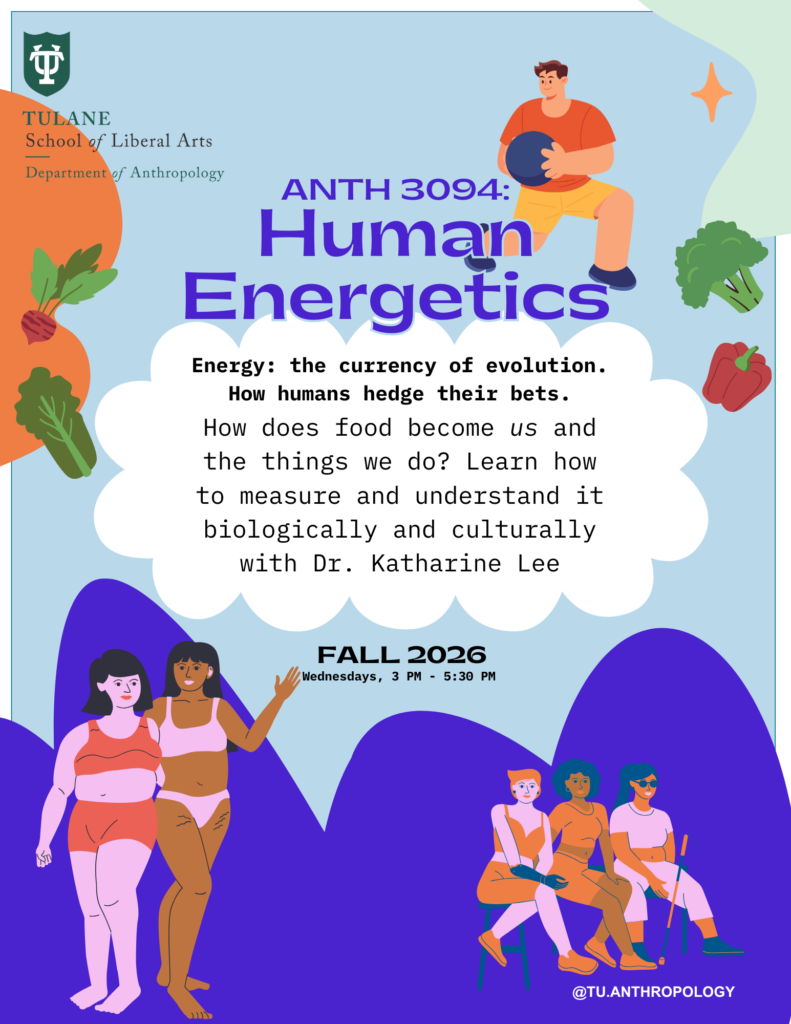
Fall 2026 Course: ANTH 3094 Human Energetics
Wednesdays 3:00PM – 5:30PM
3 credits
The course is designed as an in-depth study of human energetics from biological, biocultural, ecological, & evolutionary perspectives. Students will learn the underlying physiology of energy intake, energy metabolism, and energy expenditure; past and present methods for studying energetics; human adaptations and variation related to energetics; and the roles science, technology, and culture play in our ongoing interaction with and interpretation of the topic.
Course goals are for students to:
Have a strong grasp of the basic biology of energy intake, energy metabolism, and energy expenditure, including basic physiology, hormones, and cellular processes
2. Describe common methods for quantifying energy intake, energy balance, and energy expenditure.
3. Perform basic calculations to estimate metabolic rate and energy expenditure.
4. Provide examples & brief descriptions of factors that influence energy expenditure and metabolism.
5. Describe ways science and technology shape our understandings of energetics
This course can count as an elective towards the public health nutrition minor. Please contact the Undergraduate Public Health Studies office if you would like to use this as an elective for the minor.